
Five Critical Insights for CPQ & Billing Implementation Success
The critical decisions that connect strategy to execution across product, pricing, migration, integration, and program deliveryModern revenue operations demand more than a point solution for quoting or invoicing. They demand a connected implementation approach across product design, pricing logic, data migration, integration architecture, and program leadership. Organizations that treat CPQ and Billing as separate initiatives often create avoidable friction: product structures that quote well but bill poorly, pricing models that break downstream invoicing, migrations that disrupt continuity, integrations that require manual intervention, and teams that drift out of alignment.
At Ravus, we see these challenges surface repeatedly in complex quote-to-cash transformations. That is why our perspective on Implement & Launch is grounded in the same practical realities covered in our Five Critical Insights for a Successful CPQ / Billing Transformation series. When these decisions are made in the right sequence, and with the right cross-functional ownership, teams can launch with cleaner data, stronger adoption, and a revenue foundation built to scale.
This page brings those five insights together into a single implementation narrative: how to move from future-state design to an operational launch that supports quoting, billing, invoicing, renewals, and revenue management as one cohesive motion.
Why CPQ and Billing must be designed together
Implementing CPQ or Billing independently is already challenging. Implementing both as part of a broader revenue transformation raises the stakes: every design decision upstream affects what happens downstream. Ravus’ original five-part insight series makes this clear. Successful transformations require strategy, precision, and expertise to ensure the product catalog, pricing structure, customer records, integrations, and team operating model all work together—not in isolation.
For implementation teams, that means launch readiness is not just about configuration. It is about designing a connected revenue system that can accurately move from quote to invoice to revenue recognition with minimal manual intervention. Each stage below represents a critical checkpoint in that journey.
Stage 1: Product & Bundle Design
Build a product catalog that works across selling and billing
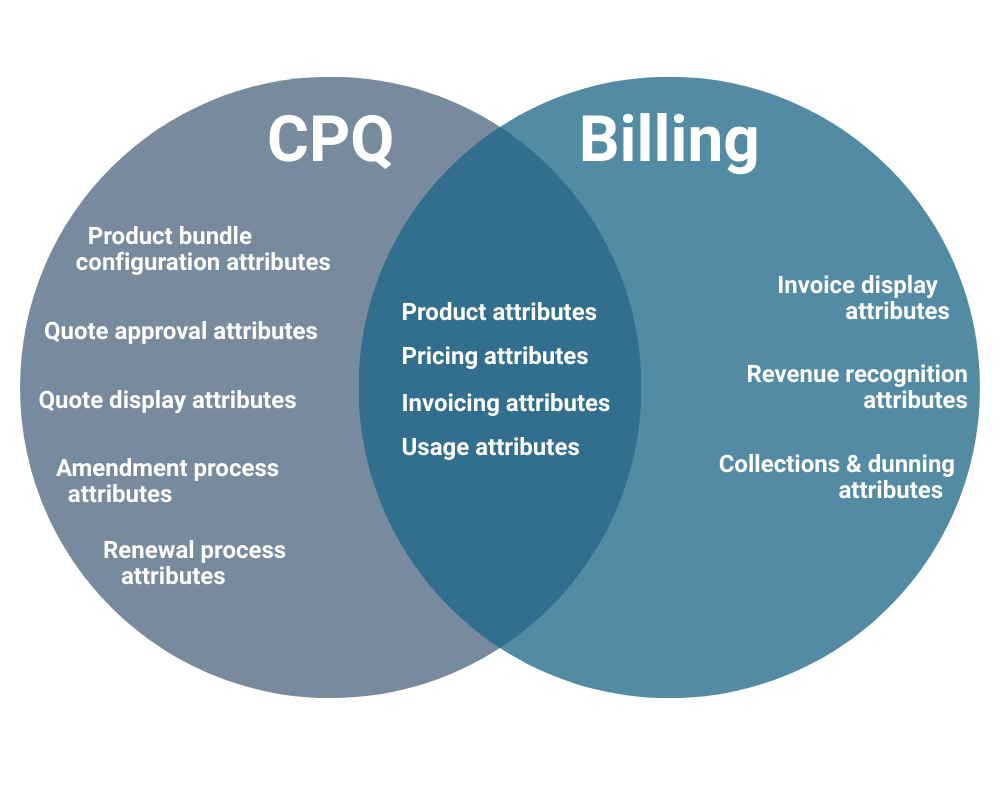
That is why product and bundle design should never be handled by the sales process alone. Selling and billing teams need to determine together where product data should originate, where it needs to persist, and how it should behave as it moves between systems. Some attributes matter only during quoting. Others matter only for billing and revenue recognition. Many matter to both.
Within an Implement & Launch engagement, this stage is where architecture becomes operational. Product hierarchy, bundle structure, amendment behavior, recurring versus one-time logic, and attribute ownership all need to be defined early enough to support downstream pricing, invoicing, and integration design. When teams skip this alignment, they often pay for it later in rework, invoicing exceptions, and reporting inconsistencies.
Stage 2: Pricing to Invoicing
Design pricing with downstream billing in mind
Once the product model is established, pricing design becomes the next major determinant of launch success. Accurate quoting, invoicing, and revenue recognition depend on a pricing and discount structure that reflects not just sales strategy, but also the needs of the billing platform and the realities of compliance.
Some requirements are dictated by system capability—for example, the level of transaction detail that can or should be sent to billing. Others are shaped by accounting and reporting requirements, such as stand-alone selling price considerations, invoice presentation needs, and the way pricing data must flow into downstream finance processes. These decisions also intersect with broader questions around account hierarchies, legal obligations, and customer expectations.
In practice, pricing is where many implementations either gain momentum or introduce long-term friction. A sound pricing design enables frictionless communication between CPQ and Billing, faster time-to-market, and clean reporting. It helps ensure every quote, invoice, and revenue entry is accurate, transparent, and scalable.
During Implement & Launch, Ravus works to align pricing logic with product structure, billing rules, and financial outcomes before teams enter late-stage build and test cycles. That reduces the risk of discovering too late that an elegant quoting model cannot be invoiced or recognized cleanly. For the original insight, visit Pricing to Invoicing.
Stage 3: Migration of Existing Customers
Treat migration as a transformation workstream, not a cutover task
A successful CPQ and Billing transformation is not limited to net-new customers. It also has to support existing customers through ongoing billing, amendments, and renewals. That makes migration one of the most consequential stages in any implementation.
Translating legacy customer data into a new, standardized data model is rarely straightforward. Existing customers and data often need to move not only into the new billing system to preserve invoicing continuity, but also into the CPQ system to support future renewals, amendments, and account changes. Depending on the quality and structure of source data, a phased migration strategy may be more effective than a full cutover at go-live.
Ravus’ migration perspective emphasizes sequencing, risk reduction, and realism. Teams may benefit from starting with simpler use cases or account groupings before progressing to more complex customer structures. At the same time, migration should not be treated as a last-mile technical exercise. It should develop alongside the future-state CPQ and Billing design, beginning with source data consolidation and cleansing.
Discrepancies across historical contracts, pricing structures, and billing schedules need to be identified before mapping can be completed. Legacy products may not map 1:1 to the new catalog. Flat structures may need to be translated into bundles. Retired products or obsolete pricing models may require exception handling. And after mapping comes the most important discipline of all: repeated testing to confirm that data lands correctly in both CPQ and Billing, that invoicing continuity is maintained, and that amendment and renewal scenarios still function as expected.
This is exactly where Implement & Launch and Integrate & Migrate intersect. A strong launch plan does not separate deployment from migration readiness. It brings them together. See Migration of Existing Customers for the source article.
Stage 4: From Silos to Synergy: Integration Considerations
Architect integrations around data movement, timing, and ownership
Even the best product, pricing, and migration design will struggle if the integration layer is weak. A CPQ-Billing integration is more than a technical handoff. It is the mechanism that keeps revenue operations synchronized.
A strong understanding of the data models and requirements for both CPQ and Billing is essential to determine the right integration strategy and identify where translation is needed. If a native connection exists, teams may gain speed but lose flexibility, especially if the integration limits how much transformation can happen in transit. If a custom integration is built, there may be more flexibility for calculations and translations in the integration layer, but the need for governance and long-term maintainability grows accordingly.
Key questions include how data will pass from CPQ to Billing, how and when the integration is triggered, what timing requirements matter for invoicing and renewals, what transformations are needed, and which system or layer owns those transformations. Teams also need to confirm whether CPQ is capturing all of the downstream data Billing requires—or whether process and design changes are needed upstream.
For Implement & Launch, integration design is not a technical appendix. It is a core workstream that shapes operational readiness, exception handling, and system scalability. The right architecture reduces manual workarounds, protects invoice accuracy, and gives the business confidence that downstream operations will keep pace with commercial complexity. Explore the original article here: From Silos to Synergy: Integration Considerations.
Stage 5: Structuring Your Team for Success
Manage CPQ and Billing as one coordinated program
The final insight is the one that holds everything else together: team structure and program management. Communication and collaboration are the cardinal rules of a successful CPQ and Billing transformation. Any initiative that treats CPQ and Billing as separate implementation projects is likely to encounter costly delays, rework, confusion, and uneven adoption.
To maintain alignment, many organizations benefit from a single SI partner overseeing the flow of both workstreams. When that is not the right model, expectations should still be established early and reinforced often so that both partners remain in lockstep throughout design, build, testing, and launch. Without a connected working model, teams attempting to move beyond silos may accidentally recreate them.
An end-to-end CPQ and Billing transformation is less likely to succeed if either workstream suffers delays or scope changes without program-level coordination. Dependency tracking and milestone mapping need to happen not only within each project, but across the broader transformation program. Risks and blockers in one workstream should be surfaced as program issues, not left isolated until they disrupt the launch.
For Ravus, this is where Implement & Launch becomes more than deployment support. It becomes a program leadership function focused on aligned timelines, confident go-live decisions, and strong user buy-in. Read the full perspective in Structuring Your Team for Success.
Why these five insights matter during Implement & Launch
Move from strategy to deployment with less revenue risk
The five insights above map directly to the work required to deploy revenue systems successfully. Product design informs pricing. Pricing affects invoicing. Invoicing and renewals depend on migration quality. Migration success depends on integration and data architecture. And all of it depends on a team structure capable of managing dependencies across the full quote-to-cash lifecycle.
That is why Ravus’ Implement & Launch services are built around more than software configuration. We help organizations design and deploy revenue lifecycle systems that account for architecture, pricing and packaging, integration readiness, migration sequencing, testing, cutover planning, and post-go-live stabilization. The goal is not simply to launch a platform. The goal is to launch an operating model that can scale.
Teams that start with Advisory Services often use these insights to define their future state. From there, Implement & Launch turns that strategy into execution. For organizations with more complex system dependencies or source-data challenges, Integrate & Migrate provides complementary support for data translation, integration architecture, and migration governance.
Launch Your CPQ and Billing Transformation with Ravus
Rushed implementations create revenue leakage, invoice exceptions, and operational drag. A structured implementation approach creates cleaner handoffs across Sales, RevOps, and Finance while improving confidence in pricing, billing, invoicing, and renewals.
Ravus helps enterprises turn revenue strategy into implementation-ready execution across CPQ, billing, integrations, migration, and post-go-live adoption. Whether you are deploying a new revenue stack, modernizing a fragmented environment, or aligning multiple teams around a future-state operating model, our Implement & Launch services are designed to help you move faster with less risk.