

Stripe + Ravus: Revenue and Payments Infrastructure Built for Production
Stripe at a Glance
Stripe gives businesses a flexible financial infrastructure for payments, subscriptions, invoicing, tax, reporting, and platform monetization. Ravus helps you turn that flexibility into a production-ready operating model: clean product and pricing design, reliable integrations, implementation discipline, and support that keeps pace with the business after launch.
Whether you are introducing recurring revenue, expanding into usage-based pricing, simplifying invoicing, or building a platform business with embedded payments, Ravus helps you design Stripe correctly, implement it cleanly, and evolve it as your business model grows.


Patrick Herrmann
Director, Stripe Practice Lead
Partner status
Stripe Premier Services Partner. Stripe Billing Specialization.
Per Stripe, "The Stripe Billing Specialization recognizes partners with a strong track record in implementing Stripe Billing solutions. These partners excel at managing complex data migrations from legacy systems and seamlessly integrating Stripe Billing into users’ tech stacks."
Engagement models
Advisory Services, Implement & Launch, Integrate & Migrate, Managed Services, and RevX for on-demand support.Design for
Subscription and usage-based businesses, B2B invoicing teams, and software platforms embedding payments.Typical outcomes
Faster time to production-ready billing, cleaner integrations, fewer billing exceptions, and less manual effort across finance.Why Stripe + Ravus
Ravus works across BillingPlatform, Nue, and Stripe on active client engagements. When Ravus recommends Stripe for a particular environment, it's because we've evaluated the fit against the alternatives we also implement. No financial incentive shapes that recommendation. That independence is the most valuable thing we bring to a platform conversation.
Modern monetization rarely fails because the software lacks capability. It fails when pricing logic, edge cases, handoffs, integrations, and operating ownership are left unresolved.
Stripe provides the building blocks to accept payments, automate subscriptions, support usage-based pricing, send invoices, manage tax, and analyze revenue data. Ravus helps you connect those capabilities to the realities of your business model, customer lifecycle, finance process, and downstream systems.
Agent-assisted delivery.
Human-supervised judgment.
In a Stripe engagement, agents expand test coverage and accelerate reconciliation at scale — practitioners own every architecture decision, integration design, and cutover call.
Agents Accelerate & Draft
- Integration mapping analysis and API and webhook documentation
- Migration test scripts for high-volume customer and subscription data
- Parallel billing output comparison and variance classification at cutover
Practitioners Own and Decide
- Every architecture, pricing design, and integration specification
- Cutover readiness and billing continuity decisions
- All production changes — reviewed and approved before deployment
Every cutover call is owned by a senior Ravus practitioner — including Stripe Certified Professional Implementation Architects with direct Stripe Billing migration experience.
What We Deliver

Stripe Advisory Services
Ravus Advisory Services help teams make better Stripe decisions before implementation begins. We assess monetization requirements, process friction, system readiness, and future-state architecture so you can move forward with clarity.
Stripe Implementation & Deployment
Ravus delivers BillingPlatform implementations across subscription, usage-based, and hybrid monetization—covering architecture, configuration, testing, UAT, cutover, and hypercare.What you get:
Ravus supports Stripe implementations with services that include:Product and pricing configuration
Subscription and usage-based billing setup
Invoice and payment workflow design
Checkout and customer self-service enablement
Revenue recognition and finance alignment
Testing, UAT, cutover, and go-live support

Integration Engineering & Data Migration
Stripe performs best when the surrounding data and system orchestration are designed intentionally. Ravus integrates Stripe with CRM, CPQ, ERP, data warehouses, product systems, and internal workflows while supporting the migration of customer, product, pricing, and contract data.
Keep Billing Accurate & Evolving
Billing and payments do not stop changing after go-live. Ravus Managed Services help you keep Stripe accurate, stable, and evolving as your business introduces new offers, geographies, and workflows.Designed outcomes:
Fewer invoice exceptions and less manual rework
Faster pricing and packaging updates
Cleaner month-end and finance handoffs
Better visibility into change impact and release quality

On-Demand Stripe Expertise
Not ready to commit to a full Stripe engagement yet? RevX gives you direct access to Ravus Stripe experts at a defined scope and price — to assess what you're actually dealing with, get a specific question answered, or begin addressing a problem before committing to something larger.Engagement models:
Strategize
Twenty hours a month with a senior Ravus specialist — enough to frame a decision, validate a direction, or get unstuck on a billing or RevOps issue before it becomes the larger transformation problem nobody wanted.Transform
Forty hours a month for teams actively working through a quote-to-cash initiative and needing stronger guidance, business-case support, transformation planning, or targeted expertise to keep momentum and reduce risk.Specialize
Some RevOps problems do not fit a standard package. Specialize is the custom engagement for teams that need the right people, duration, and delivery model for a highly specific business or technical need.Stripe is built to be accessible.
Here's where the complexity lives.
Stripe's APIs make it possible for a technical team to get started quickly. What takes longer, and where most implementations run into trouble, is what comes after the initial integration: pricing model edge cases that only appear when a real customer hits an unusual billing scenario, usage metering logic that has to be right before it reaches an invoice, tax handling across jurisdictions, revenue recognition aligned to how finance needs to close, and the downstream integrations that keep CRM, ERP, and data systems in sync with what Stripe is doing.
Ravus adds the most value at those inflection points — not because Stripe is hard to configure, but because the operating model decisions made in the first four weeks of a Stripe implementation are the ones that determine how much rework is required in month eight. Getting those decisions right before the build begins is where the return on a consulting engagement is highest.
Stripe capabilities we help you operationalize
Migrations and integrations
Stripe Billing & usage-based monetization
Tax, revenue recognition, and reporting
Payments, checkout, and invoicing
Connect for platforms and marketplaces
Ravus products & accelerators for Stripe teams
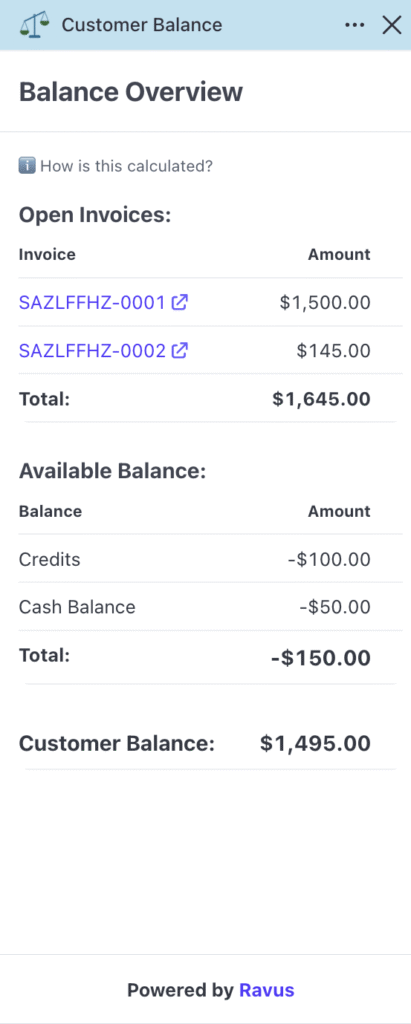
Customer Balance App
The Customer Balance App provides a real-time view of a customer’s current balance and the underlying transactions behind it. Designed for Stripe Invoicing and Billing users, it helps teams quickly understand what a customer owes, review open invoices and invoice balance activity, and gain clearer insight into outstanding amounts.
- Real-Time Balance Tracking: See what each customer owes at a glance
- Seamless Integration: Works directly within the Stripe dashboard for a frictionless experience
- Improved Cash Flow: Stay on top of receivables and reduce payment delays
Insights & Resources
Stripe, OpenRouter, and a Familiar Playbook
Patrick Herrmann on why Stripe's OpenRouter acquisition follows the same playbook that made Stripe the default for payments — now applied to AI models.
Billing Software Trends 2026: The Modern Monetization Stack
Why hybrid pricing, metering, compliance, and automation are changing the requirements for modern billing systems.
Software Options to Support Usage-Based Pricing
A practical Ravus perspective on the software patterns and operational considerations behind usage-based monetization.
Stripe Frequently Asked Questions
Ready to get the details right in Stripe?
Stripe implementations succeed or fail in the details: the pricing edge cases that only surface when a real customer hits an unusual billing scenario, the meter-to-invoice logic that has to be right before it reaches finance, the downstream integrations that everyone assumed were handled. That is the work we show up for.
We're a small team from Montana. We'll tell you where we think the risk is, what we would do about it, and whether a full engagement is the right next step or whether a RevX conversation would tell you more. Let's talk."