
How to De-Risk a Billing Platform Migration with Parallel Bill Runs
Parallel bill runs help organizations validate billing behavior before cutover by comparing outputs, surfacing gaps, and creating confidence that migration decisions will hold up under real-world conditions.
Ravus helps teams reduce migration risk through structured validation, tighter sequencing, and a stronger path to billing continuity.
In short
Why Billing Migration Risk Matters
Billing migrations are high-stakes because errors rarely stay contained inside the system team. They affect invoicing, collections, customer experience, reporting, and executive confidence.
Weak validation creates downstream business risk
When billing outcomes are not validated early enough, the organization risks invoice mismatches, revenue disruption, manual cleanup, and loss of confidence in the migration program.
Cutover pressure rises faster than certainty
Migration timelines often keep moving toward go-live even when teams still lack enough confidence in the output, edge-case handling, or readiness of the target environment.
The cost of finding issues late is much higher
The later a billing mismatch is discovered, the more expensive it becomes to resolve. What could have been addressed in validation turns into operational disruption after cutover.
How a Parallel Bill Run Works
The same billing scenario runs through both systems, so differences surface before cutover — not after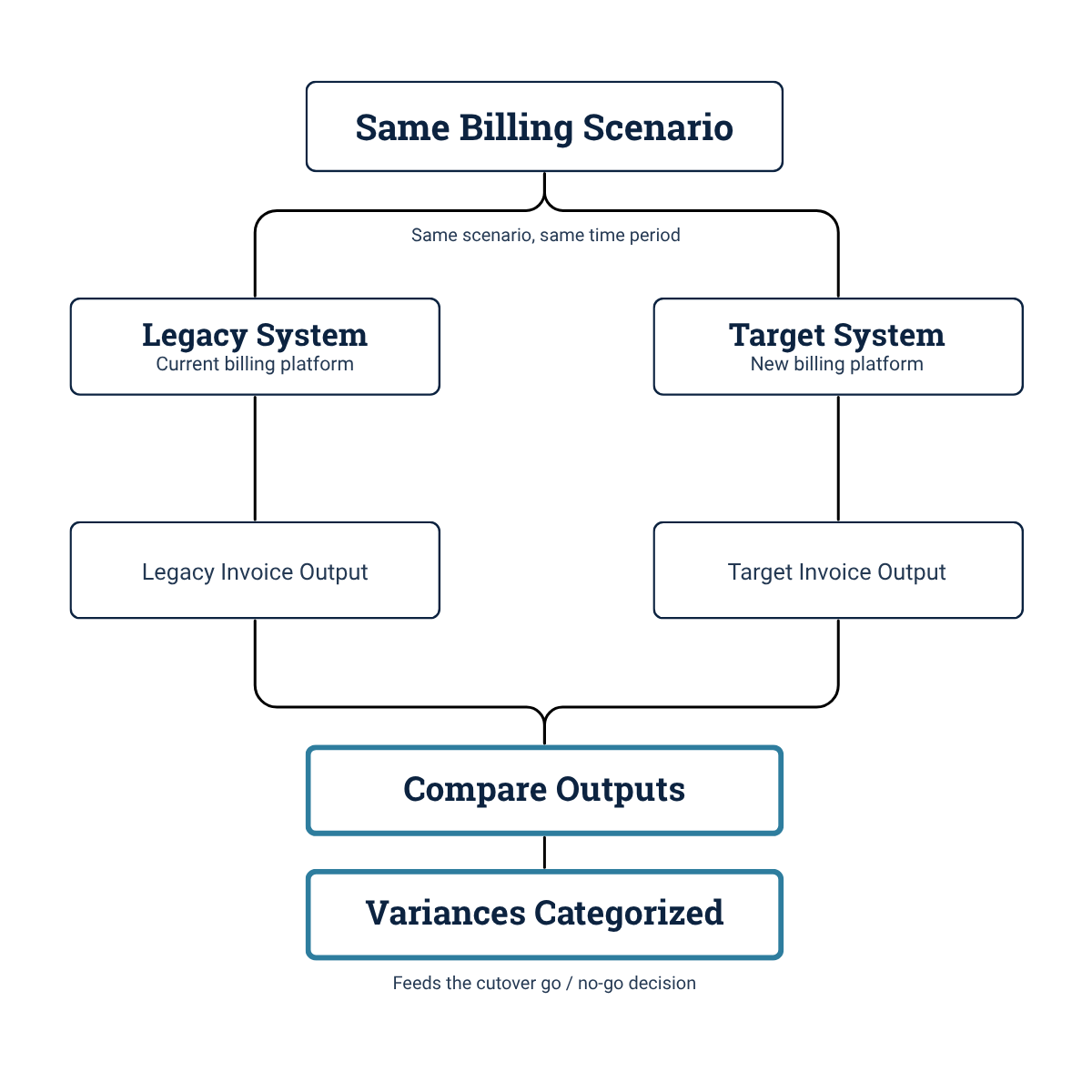
What Billing Migration Risk Looks Like in the Real World
Billing migration risk usually becomes visible through gaps between technical readiness and operational confidence.
The new platform is configured, but trust in the output is still low
Teams may feel technically ready without feeling operationally confident that the new environment can produce the right billing outcomes under real conditions.Legacy billing logic is more complex than expected
Historical workarounds, edge cases, product-specific rules, amendments, and future-effective changes often behave differently than the documentation suggests.Data mapping looks right until real billing is compared
A migration can appear clean at the data level while still producing differences in invoice behavior, rating, tax treatment, timing, or downstream revenue impact.Go-live pressure rises before validation is complete
Programs often feel forced toward cutover timelines even when there are still unresolved variances or uncertainty around readiness.Teams are not aligned on what “ready” means
IT, billing operations, finance, and program leadership may each have different definitions of acceptable variance, acceptable risk, and actual cutover readiness.Issues are discovered too late
Without structured comparison, the most important gaps often surface only when the migration is already under pressure.What Ravus Helps You Build or Fix in Billing Migrations
Ravus helps teams move from “configured” to “validated” by strengthening the parts of the migration that determine whether billing continuity will actually hold up.
Stronger validation before cutover
Ravus helps teams validate the target billing environment using real billing conditions and meaningful comparison criteria before they commit to cutover.Clearer readiness criteria across teams
Ravus helps IT, Billing Ops, Finance, and program leadership align around what must match, what variance is acceptable, and what conditions must be true before go-live.A safer path to billing continuity
The goal is not just to migrate data. It is to preserve billing continuity, reduce operational surprises, and make cutover decisions with more confidence.Sorting Variances by What They Actually Mean
Not every difference between legacy and target output carries the same risk- Rounding differences
- Formatting / display changes
- Timing differences
- Proration variances
- Rating logic mismatch
- Tax treatment errors
- Revenue impact discrepancies
How to De-Risk a Billing Migration with Parallel Bill Runs
Parallel bill runs are most effective when they are part of a broader validation and cutover-readiness strategy, not just a last-minute confidence exercise.
Define what needs to match
Compare like-for-like billing outcomes
Parallel bill runs are most useful when they compare real billing conditions, not just isolated data samples or narrow technical tests.
Track variances systematically
Differences should be categorized by severity, root cause, and readiness impact rather than treated as generic defects.
Use the results to strengthen cutover decisions
The purpose of parallel validation is not just testing. It is decision support for timing, risk acceptance, and go-live readiness.
Protect continuity during transition
The migration plan should connect validation, operational readiness, fallback thinking, ownership, and communication across teams so the move can happen with less disruption.
From Configured to Validated
Two different definitions of "ready." Only one is a decision you can trust.Confidence
Low
Confidence
High
FAQs About Parallel Bill Runs and Billing Migration Risk
These are the questions leaders ask when a billing migration is moving toward cutover but confidence in the output is still not high enough.
How Ravus Helps De-Risk Billing Platform Migrations

Integrate & Migrate
Use Integrate & Migrate when the priority is migration rigor, trusted validation, safer cutover, and continuity across systems.
Advisory Services
Use Advisory Services when the program needs a stronger readiness model, clearer risk framing, and better alignment on what good validation should look like.
Implement & Launch
Use Implement & Launch when the migration depends on deeper redesign or configuration improvements in the target billing environment.
BP Stream
Use BP Stream when the migration also needs cleaner, real-time Salesforce-to-BillingPlatform connectivity without middleware sprawl.Explore Related Billing and Quote-to-Cash Problems
Teams preparing for billing migration often also need to strengthen the business case for change, improve time to close, reduce invoice exceptions, or address deeper integration fragility.
Proof from Complex Revenue Operations Environments
Large-Scale Subscription Billing Migration for a Global SaaS Company
A global SaaS company needed to consolidate fractured billing and payment infrastructure across US and EU environments — retiring Zuora in favor of Stripe Billing for all recurring subscription management. Ravus owned the migration workstream end to end: custom ETL scripting, a disciplined 35-step cohort routine, payment method migration to preserve auto-pay, and Subscription Schedules to carry forward future-effective changes already queued in the source system.
KEY OUTCOMES: ~150,000 customers and subscriptions migrated → Payment methods preserved across US and EU → Billing continuity maintained at cutover
Modernizing Billing and Revenue Operations for a Global Healthcare Organization
A global leader in digital health and medical devices engaged Ravus in a multi-year initiative to unify billing, CPQ, and revenue operations across four legal entities — replacing fragmented, spreadsheet-driven processes inherited from multiple acquisitions. Ravus led the full technical transformation: BillingPlatform as the billing and revenue system of record, Salesforce CPQ configuration, bi-directional integrations to BillingPlatform, and a NetSuite connector for invoice delivery and financial close.
KEY OUTCOMES: Improved close timelines → Material revenue leakage recovered → Manual invoicing significantly reduced across four legal entities