
By Ashley Bailey, Director & Nue Practice Lead at Ravus
July 20, 2026 | 15 minute readIn March 2025, Salesforce quietly ended an era. After years of slowing development and strategic hints, the company officially announced that Salesforce CPQ — the SteelBrick-based managed package that has been the quoting backbone for thousands of B2B companies — had entered End of Sale. No new licenses. No new features. A clear signal that the product's shiny future is behind it, not ahead.
That announcement is now hitting RevOps teams in full force. If your organization is running Salesforce CPQ today, 2026 is the year to stop deferring the decision and start making one.
Here is what you actually need to know.
What "End of Sale" Means — and What It Doesn't
End of Sale is not End of Life. Existing customers can still renew licenses, still open support tickets, and still run their current configurations. The lights are on.
What has changed is the trajectory. Feature development for legacy CPQ has effectively ceased. Salesforce's R&D investment, executive attention, and partner ecosystem energy have all shifted to Revenue Cloud Advanced (RCA) — formerly Revenue Lifecycle Management, now sometimes referred to as Agentforce Revenue Management. The rebranding alone is worth noting: this is a product that has changed names multiple times in a short span. That reflects a platform still finding its footing.
The honest picture: your CPQ system will continue to function in the near term. But what changed in March 2025 is not just product availability — it is where Salesforce is pointing its engineering and roadmap investment. CPQ is not it.
That matters for a specific reason. Every customization you add from here, every workaround you build, every integration you maintain becomes migration liability — not just on a Salesforce path but on any path forward. Sunk cost in a frozen platform compounds. The real question for RevOps leaders is not whether to eventually move. It is how long you can justify continuing to invest in a product whose vendor has already decided what comes next.
The question for RevOps teams is not whether to act. It is when and how.
The Revenue Cloud Advanced Path: What Salesforce Doesn't Lead With
Salesforce is positioning Revenue Cloud Advanced as the natural successor to CPQ. In practice, it is not an upgrade — it is a full reimplementation.
That distinction matters enormously for planning purposes. Every configuration, price rule, quote calculator plugin, and approval workflow built inside your current CPQ environment must be rebuilt from scratch in RCA. There is no migration path in the conventional sense. The data model is different. The business logic layer is different. The UI is different. What you have accumulated in CPQ does not transfer.
None of this means RCA is the wrong choice. For organizations that are deeply committed to Salesforce as their system of record, have the runway to execute a multi-phase rebuild, and are willing to make the investment, it is engineered for enterprise scale and is Salesforce's declared future. The integration story within the Salesforce ecosystem is its strongest argument.
The risks worth taking seriously: RCA is still maturing. The platform has gaps that are being addressed release by release, not all at once. Organizations that rush migration under commercial pressure — or because Salesforce has made staying on legacy CPQ increasingly uncomfortable — risk landing on a platform that is not yet stable enough to support their most complex quoting scenarios.
If you go this route, go deliberate. Budget the time. Don't attempt to layer in Agentforce AI capabilities simultaneously with the core migration. Get your data clean and your product catalog rationalized first. The quality of what you bring in determines the quality of what you get out.
The Third-Party Alternative Path: More Options Than the Conversation Suggests
Not every organization needs to follow Salesforce's migration road. A growing number of RevOps teams are treating the CPQ transition as an opportunity to reconsider whether their quoting infrastructure should live inside the Salesforce ecosystem at all.
This is where platforms like Nue become worth examining closely. Nue is built natively on Salesforce — which means it preserves your core Salesforce objects: opportunities, products, price books, quotes, orders, assets — while delivering a modern, business-user-managed quoting experience that does not require constant developer involvement. For teams migrating off legacy CPQ, this significantly reduces the scope of what needs to be rebuilt, because the underlying architecture stays familiar.
What makes Nue particularly relevant is that it is purpose-built on the same Salesforce foundation your team already knows, while removing your dependency on a product Salesforce has stopped building. For RevOps teams that have already invested heavily in CPQ customizations, Nue offers a path that does not require scrapping that institutional knowledge or starting over on an unfamiliar data model.
Other alternatives have staked out territory in this space — Subskribe, Logik, and Conga among them. The right choice depends on your existing tech stack, your billing system, your ERP integrations, and where your quoting process breaks down today. There is no universal answer, and anyone who tells you otherwise is selling something.
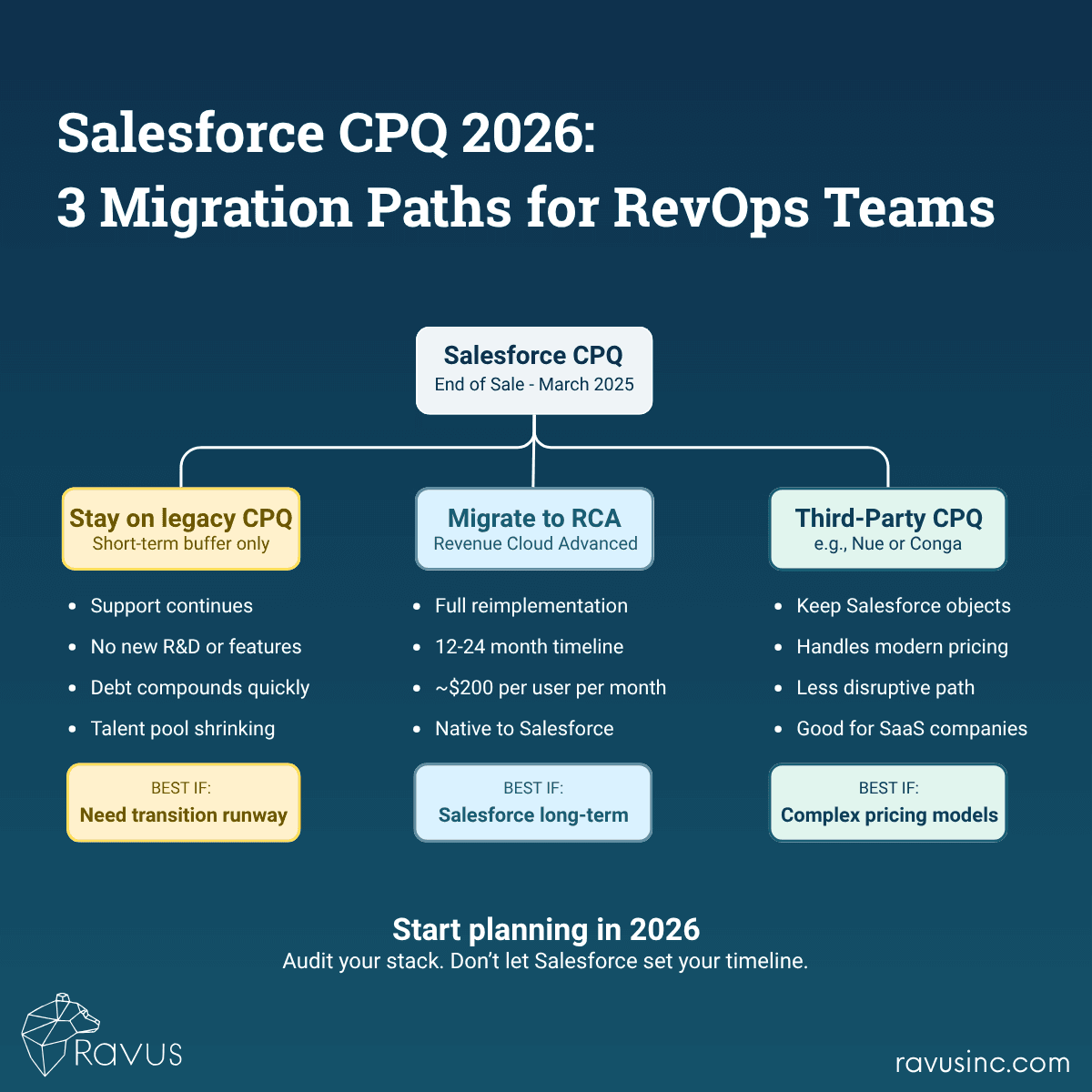
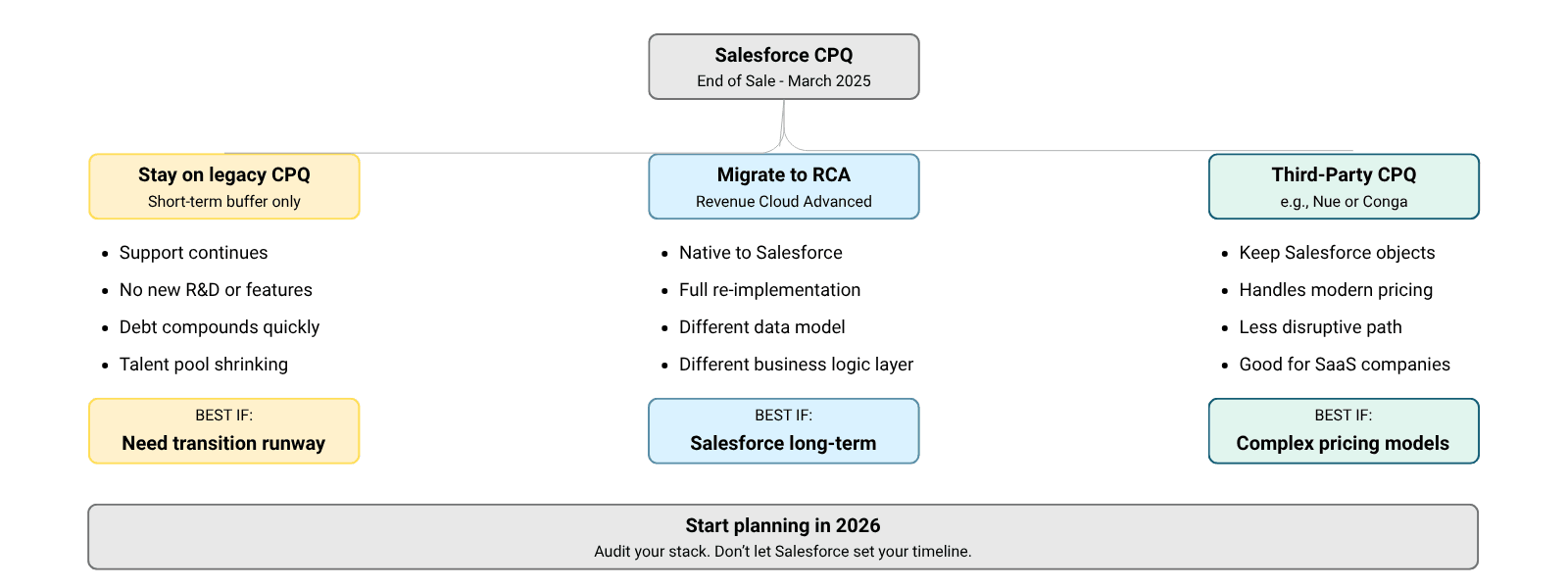
Salesforce CPQ 2026: Three Migration Paths for RevOps Teams
What RevOps Teams Should Do Right Now
The worst outcome is a panicked migration in 2027 because commercial pressure from Salesforce forced the issue. The second-worst outcome is staying on legacy CPQ indefinitely because the decision felt too big to make.
Neither is necessary. Here is where to focus:
Audit your current CPQ environment before you go anywhere. Map your customizations: Apex code, price rules, quote calculator plugins, approval workflows, and integrations to your billing system and ERP. This is the true scope of any migration — and it is the most important thing to understand before evaluating any destination platform. Until you know what you have, you cannot accurately price, plan, or sequence a move.
Treat your customizations as migration liability, not as reasons to stay. Everything you have built on top of legacy CPQ will need to be rebuilt on whatever comes next. That is not an argument for staying put — it is an argument for moving before the list grows longer. Every new workaround you add today is another line item on a future project plan.
Be honest about your Salesforce commitment. Revenue Cloud Advanced is the right answer if Salesforce is your long-term system of record and you have the appetite for a multi-phase rebuild. If your stack is multi-CRM, or if a future acquisition or integration scenario might complicate that picture, the value of a Salesforce-native but vendor-aware platform increases.
Start now, not when Salesforce tells you to. Organizations that begin migration planning in 2026 control the outcome. Those that wait until 2028 will be executing under a different set of pressures — shrinking talent pools, reduced support quality, and less negotiating leverage on contract terms.
Partner carefully. The Revenue Cloud Advanced ecosystem is still young. Not all implementation partners have the depth of experience to navigate a reimplementation at this level of complexity. Vet for Q2C specialization, not just general Salesforce credentials.
The Bottom Line
Salesforce CPQ is not going away tomorrow. But it stopped evolving over a year ago, and the gap between what the platform can do and what Salesforce is building toward is widening every quarter. The cost of that gap is not just technical — it is the cost of continued investment in something that is no longer on the roadmap.
2026 is the year to understand that clearly and make a deliberate choice about what comes next.
At Ravus, we work with RevOps teams navigating exactly these decisions — across Nue, Stripe, and BillingPlatform, and alongside the broader quoting and billing infrastructure that surrounds them. We don't have a stake in which path you choose. We have a stake in you choosing it with clear eyes and a realistic plan.
If you're trying to get your arms around this decision, we're glad to think through it with you.
Ashley Bailey