
How to Reduce Time to Close in Complex Quote-to-Cash Environments
Billing data arrives late. Exceptions are discovered too far downstream. Reconciliation requires manual effort across systems that were never designed to provide a single, trusted view of the revenue lifecycle.
Ravus helps teams reduce time to close by improving data integrity, operational ownership, and the systems architecture behind quote-to-cash.
Revenue Operations Maturity Model: 4 Stages of Q2C Readiness
Why Reducing Time to Close Matters
A slower close is not just a finance-efficiency issue. It affects confidence in reporting, strains decision-making, and makes it harder to scale cleanly as revenue operations grow more complex.
Slow close signals deeper quote-to-cash strain
Reconciliation work grows when billing data cannot be trusted
The more teams rely on spreadsheet checks, offline analysis, and manual investigation, the less confidence they have in the underlying revenue operating model.
Month-end pressure hides structural problems
The longer close takes, the harder it becomes to distinguish temporary friction from structural breakdown across billing, RevOps, finance, and IT.
Where Close Time Gets Lost
Four-stage close cycle · flagged boxes are the most common sources of delayDuring the Month
Usage, amendments accrueBilling Output
Invoices, revenue schedulesReconciliation
Across CRM, CPQ, billing, ERPClose Sign-off
Reporting confirmedWhat Close Delays Look Like in the Real World
Close friction usually appears as a finance problem first, but it often begins much earlier in the quote-to-cash lifecycle.
Billing data cannot be trusted mid-month
Issues are discovered too late because invoice output, amendments, usage records, or revenue schedules are not consistently visible or reliable before close.Manual entry and exception cleanup drive delays
Close gets slower not because the process is poorly managed, but because too much of the revenue lifecycle still depends on manual intervention.Channel expansion introduces duplication and inconsistency
Finance, RevOps, billing operations, and IT each have partial visibility, but no shared trusted picture of what should have happened and what actually did.Reconciliation spans too many systems
Teams move between CRM, CPQ, billing, ERP, spreadsheets, and support logs just to understand what happened and whether the numbers can be trusted.Process ownership is fragmented
Close issues persist when no single team owns the end-to-end integrity of quote-to-cash handoffs, billing output, and downstream finance impact.Growth increases pressure faster than control maturity
New products, pricing models, channels, and acquisitions add complexity faster than the current controls and architecture can absorb.One Number, Six Systems
What Finance has to manually reconcile every close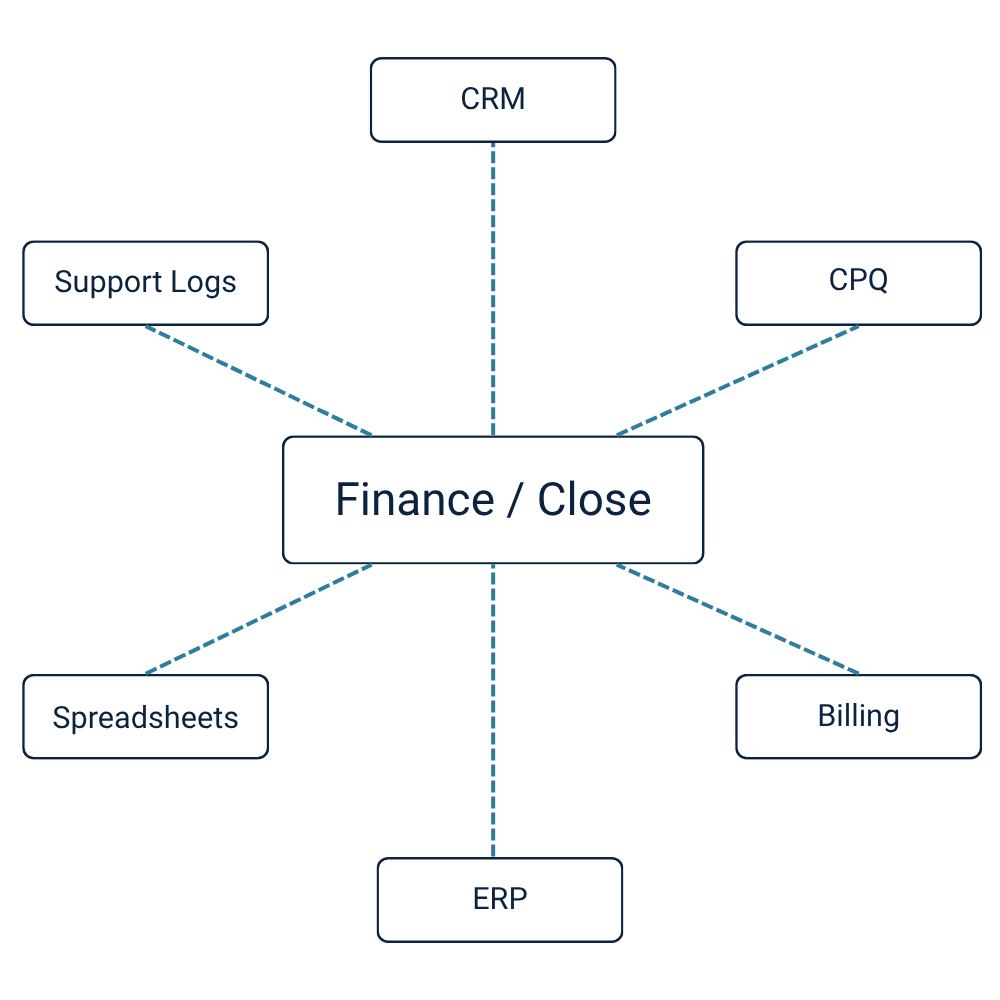
What Ravus Helps You Build or Fix for Faster Close
Ravus helps organizations move from reactive month-end cleanup to a more controlled, trusted quote-to-cash environment.
Stronger trust in quote-to-cash data
Ravus helps teams improve the reliability of billing and revenue data across systems so finance is not discovering critical issues at the end of the process.Clearer handoffs and ownership across teams
Ravus helps define where billing, finance, RevOps, and IT responsibilities start and end so close does not stall in the gaps between functions.A more controllable operating model
The goal is not only to shorten close. It is to reduce the conditions that keep creating reconciliation work, uncertainty, and month-end pressure.Reactive Close vs. Controlled Close
Where close time actually goes, before and after fixing the upstream causesMost of close spent on cleanup, not confirmation
Most of close spent confirming, not chasing
Illustrative - proportions only, not measured client data. Track your own days-to-close and reconciliation-hours split to see where your close actually falls.
How to Reduce Time to Close in Quote-to-Cash
The fastest way to shorten close is to fix the upstream conditions that keep creating downstream reconciliation work.
Diagnose the bottlenecks upstream of close
Distinguish accounting symptoms from revenue-operations causes
Some close delays look like finance problems, but begin much earlier in billing design, cross-system handoffs, and quote-to-cash operations.
Improve visibility before month-end
The goal is not just to close faster. It is to create confidence earlier, so teams are not discovering critical issues at the end of the process.
Align handoffs and ownership
Faster close requires clearer cross-functional accountability, not just more effort from finance during month-end.
Redesign what keeps creating reconciliation work
Where delays are structural, organizations need system and process improvements, not just better tolerance for manual cleanup.
FAQs About Time to Close in Quote-to-Cash
How Ravus Helps You Reduce Time to Close

Advisory Services
Use Advisory Services when the priority is diagnosing the root causes behind close friction, clarifying what is broken, and defining a roadmap before major change.
Implement & Launch
Ravus helps you design and deploy a quote-to-cash and billing environment that can support new monetization models in practice, not just in theory.
Managed Services
Use Managed Services when teams need to reduce operational strain, improve consistency, and accelerate improvements in a live environment.
Integrate & Migrate
Use Integrate & Migrate when the biggest blockers are data integrity, cross-system reliability, and the architecture behind how quote-to-cash information moves.Explore Related Billing and Quote-to-Cash Problems
Proof from Complex Revenue Operations Environments
BillingPlatform Managed Services: Stabilizing Complex Billing for a DTC Logistics Provider
A leading 3PL came to Ravus after inheriting an incomplete BillingPlatform implementation from a prior vendor — 150+ products in the catalog, most unused, and finance still handling complex invoices manually through a legacy system. Ravus delivered a focused managed-services engagement that automated Free Text Invoice billing, cleaned up the catalog, and moved the operation into a single, working system without disrupting a single active billing flow.
KEY OUTCOMES: Dozens of invoices automated monthly → ~60 catalog cleanup items packaged → Zero disruption to live billing
Modernizing Billing and Revenue Operations for a Global Healthcare Organization
A global leader in digital health and medical devices engaged Ravus in a multi-year initiative to unify billing, CPQ, and revenue operations across four legal entities — replacing fragmented, spreadsheet-driven processes inherited from multiple acquisitions. Ravus led the full technical transformation: BillingPlatform as the billing and revenue system of record, Salesforce CPQ configuration, bi-directional integrations to BillingPlatform, and a NetSuite connector for invoice delivery and financial close.
KEY OUTCOMES: Improved close timelines → Material revenue leakage recovered → Manual invoicing significantly reduced across four legal entities
Make Close Easier by Fixing What Slows It Down Upstream
If month-end pressure is rising because billing and quote-to-cash operations are too fragmented, Ravus can help you identify the causes and define a more reliable path forward.
The goal is not just to close faster at month-end. It is to build a quote-to-cash environment that creates less reconciliation work, more trust, and better control throughout the month.