

Key Takeaways: Top Billing Software Trends for 2026
- Hybrid pricing (subscription + usage + credits) is becoming the default operating model
- Metering is now a first-class platform primitive, not a bespoke analytics job
- Real-time entitlement visibility enables better cost controls and proactive customer management, avoiding costly overages for both company and customer
- Compliance (especially e-invoicing) is forcing billing modernization on 2026 timelines in multiple jurisdictions
- Vendors are betting on automation (including AI-assisted collections and operations) to reduce revenue leakage and DSO
Billing is Becoming Monetization Infrastructure
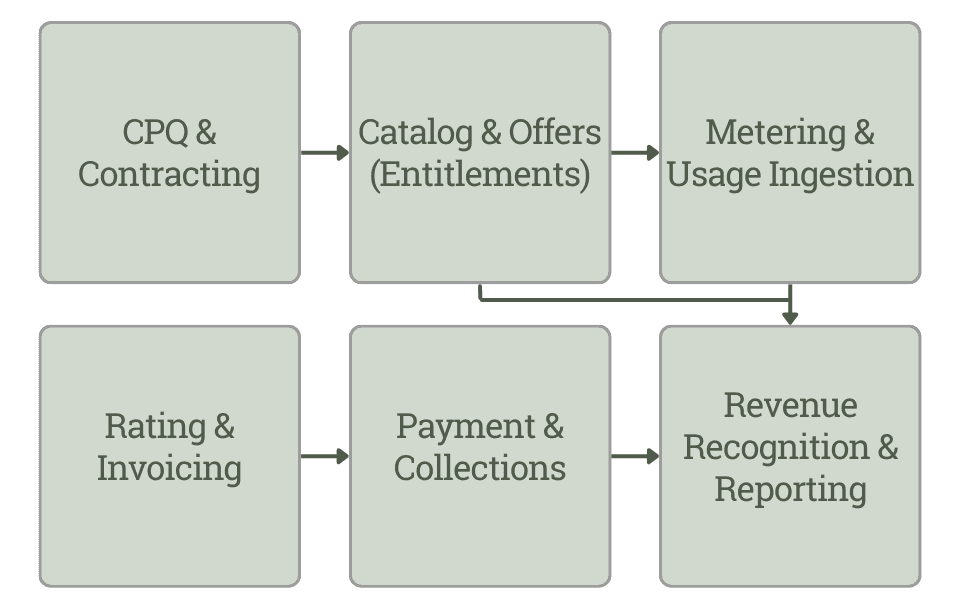
Billing is evolving from a monthly invoicing function into monetization infrastructure: a connected set of capabilities spanning product catalog, subscriptions, usage metering, rating, invoicing, payments, collections, tax, and revenue recognition. The center of gravity is shifting toward variable value—API calls, tokens, compute, and outcome-driven pricing—which forces billing platforms to behave more like real-time data systems and raises the bar for reconciliation, invoice clarity, and auditability.
The market is also converging on advanced usage monetization as a core differentiator—reflected in Stripe’s acquisition of Metronome and the push toward billing-grade metering, rating, and orchestration for complex usage models that can reduce disputes and revenue leakage.
In parallel, platforms like BillingPlatform are doubling down on configurable catalog and rating capabilities that help enterprises launch and govern hybrid offers without sacrificing billing accuracy, close velocity, or finance-grade controls. Nue is taking a complementary approach by positioning quote-to-revenue as a unified workflow—bringing CPQ, subscriptions, billing, usage, and analytics together to reduce quote-to-invoice drift and improve end-to-end revenue execution.
The 8 Trends Reshaping Billing in 2026
1. Hybrid Monetization Becomes the Default (Subscription + Usage + Credits)
Billing leaders are moving from single-model subscriptions to blended constructs: base fees plus metered overages and consumption limits, seat-based access plus consumption add-ons, and credit drawdowns. BillingPlatform’s subscription billing messaging explicitly pairs subscription models with versatile usage-based billing across any metric.. Stripe similarly describes usage-based billing as a common SaaS model and provides a defined implementation lifecycle.
Hybrid monetization shifts billing from a monthly accounting task into a real-time monetization capability that must stay aligned across product, finance, and customer experience. The operational challenge isn’t just calculating charges - it’s ensuring usage is captured and rated reliably, monitored for abuse, and communicated clearly enough to prevent “mystery bills” and disputes.
2. Metering vs. Rating: Core Capabilities for Usage-Based Billing
Usage pipelines are becoming billing-grade: immutable events, well-defined aggregation rules (meters), replay and backfill capabilities, and customer-visible consumption reporting. In this model, usage isn’t just analytics. It becomes a financial source of truth that must support audits, dispute resolution, and predictable revenue operations.
As usage-based and hybrid pricing expand, teams increasingly separate metering (turning raw events into trustworthy quantities) from rating (applying pricing logic such as tiers, volume discounts, overages, minimum commitments, or credit drawdowns). This separation makes pricing changes safer and faster: you can evolve rate plans without rewriting event instrumentation, and you can re-rate historical periods when contracts change or usage arrives late.
The result is a billing foundation that scales with product complexity while reducing exceptions, speeding month-end close, and improving customer trust through transparent, reconcilable usage.
Navigating Billing Ecosystem Changes: A Program Management Playbook
3. Entitlements & Billing: Tie Product Access to Commercial Terms
As offers multiply, entitlement management reduces operational risk by ensuring customers receive exactly what they purchased - no more, no less - across upgrades, downgrades, trials, pauses, and cancellations. Stripe’s entitlements are designed to grant and revoke feature access based on subscription state and to support pricing experimentation without changing application code.
This tight coupling between commercial terms and product access helps prevent revenue leakage, reduces support tickets, and makes packaging changes safer to roll out. In practice, it also shortens the path from “new SKU” to “shippable offer” because entitlement rules can be updated alongside catalog and billing changes rather than requiring a full engineering release.
4. Rating and Billing Engines Prevent Cost Overruns
5. Quote-to-Revenue Convergence: Reduce Quote-to-Invoice Drift
As monetization models become more dynamic, the handoffs between CPQ → contract → provisioning / entitlements → billing → reporting can no longer tolerate translation gaps. “Quote-to-invoice drift” shows up when the quote structure can’t be represented cleanly in billing (or vice versa): bundles get flattened, usage terms get interpreted differently, proration rules diverge, discounts don’t apply as expected, or amendments aren’t reflected consistently across systems. The result is predictable pain - manual billing exceptions, invoice disputes, slower renewals, and forecasting noise for Finance.
To address this, CPQ, subscriptions, billing, and analytics are increasingly packaged together (or tightly orchestrated) so the commercial model is defined once and executed consistently end-to-end. Nue positions itself as a unified quote-to-revenue platform combining CPQ, subscriptions, billing, usage, and analytics - an approach maintaining a single commercial source of truth from initial quote through recurring and usage-based charges.
In 2026, the winners are organizations that treat quote-to-revenue as a productized workflow: if you can quote it, you can contract it, and you can bill it.
6. Billing Automation Extends into AR: Collections, Disputes, and Cash Visibility
Billing outcomes are judged by cash velocity, not just invoice accuracy. Several billing providers position their collections capabilities as AI-powered and tightly connected to billing and revenue data, reflecting a broader shift toward embedded AR workflows rather than bolt-on tools.
As hybrid pricing expands, exceptions (late usage, credits, prorations, contract changes) tend to increase, so automating dispute triage, credit issuance, and reason-coded adjustments becomes essential to protect customer trust and reduce days sales outstanding (DSO).
The practical goal in 2026 is a closed-loop process where invoicing, dunning, and cash application share the same source data and give Finance real-time visibility into what’s billed, what’s at risk, and what will convert to cash.
7. Advanced Usage Monetization: Credits, Commitments, and Plan Versioning
Leading platforms are investing in richer usage constructs: multiple usage attributes, plan versioning, real-time credit burn, and large rate-card scale. Stripe’s advanced usage-based billing overview calls out plan versioning and credit management capabilities, and Stripe’s acquisition of Metronome signals deeper investment in orchestrating complex usage-based models.
The key shift is moving beyond “metered add-ons” to finance-grade constructs like minimum commitments, prepaid drawdowns, and automated true-ups that can be audited and explained to customers. In 2026, this maturity becomes a competitive differentiator because it enables pricing innovation without introducing billing exceptions, delayed closes, or customer trust erosion.
8. E-Invoicing Compliance in 2026: Structured Formats, Routing, and Archiving
Compliance requirements are accelerating, with structured formats, network routing, and sometimes clearance models. Belgium’s B2B structured e-invoicing requirement began Jan. 2026, and Deloitte outlined phased UAE adoption starting with a pilot in July of this year with mandatory timelines tied to business size.
Conclusion: Choose a Stack That Ships Offers Safely & Bills Precisely
In 2026, billing is a strategic system that must serve product innovation, customer trust, finance integrity, and regulatory compliance, all at once. Organizations that invest in metering, catalog governance, and end-to-end workflow automation will be able to ship new monetization models faster while reducing revenue leakage, disputes, and audit risk.
The practical differentiator is operational readiness: treating usage as a financial source of truth, versioning offers and rate plans with clear approvals and traceability, and ensuring CPQ, entitlements, invoicing, and AR stay aligned as products evolve. Teams that modernize with this mindset don’t just “upgrade billing” - they gain a durable monetization foundation that supports experimentation, scales globally, and turns billing accuracy into faster cash conversion and stronger customer retention.
Next Step: Align Your Offer Roadmap to Your Event Model
Align your monetization roadmap (what you want to sell) with your event model (what you can measure), then evaluate platforms based on how safely and quickly they can evolve pricing without breaking finance or compliance.
RAVUS CAN HELP

Comprehensive Revenue Operations Assessment & Optimization Roadmap
Validate Revenue Strategy & Technology Before Full-Scale Investment
FAQs: Usage-Based Billing, Metering, and Platform Selection
Mitch Colyer