
Why Quote-to-Revenue Breaks Down
Most quote-to-cash implementations break down in one place:
What’s sold does not always match what gets billed.
You built the product. The pricing model is ready. Sales is prepared to quote it. Finance is prepared to bill it.
On paper, the next step sounds simple: connect Salesforce to BillingPlatform and let the revenue lifecycle run.
In practice, that is where many teams create a long-term operational problem. They introduce middleware flows, custom orchestration, sync jobs, exception tables, and integration logic that gradually becomes harder to understand than the commercial process it was supposed to support.
That is exactly the gap BP Stream is designed to close.
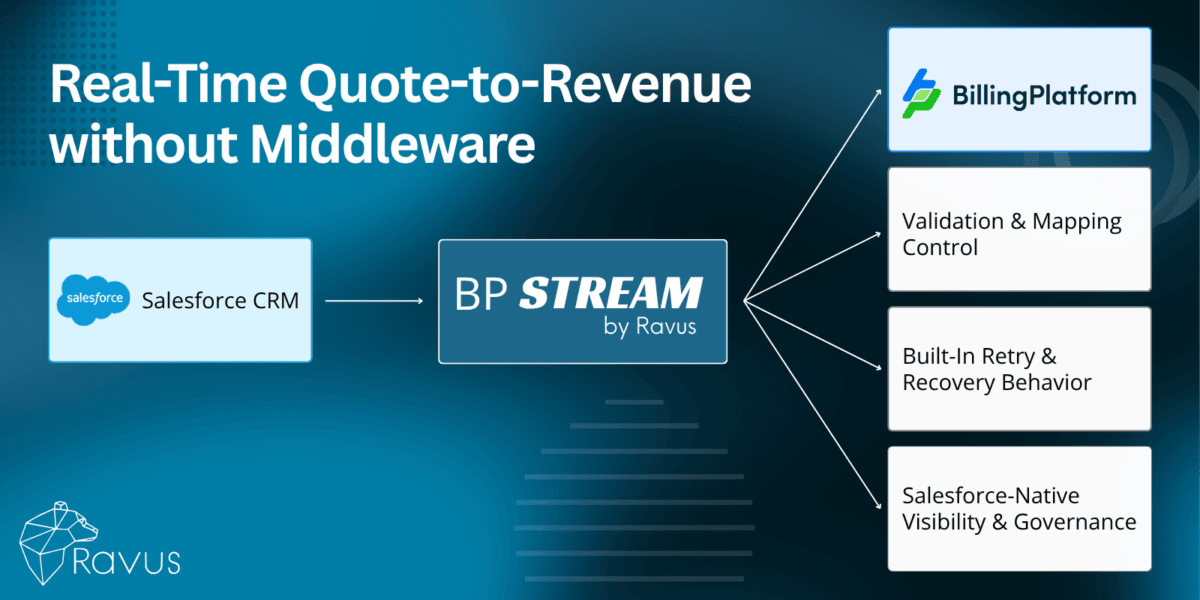
BP Stream is a Salesforce-native, real-time revenue connector between Salesforce and BillingPlatform. It gives RevOps, product, finance, and systems teams a direct way to manage how products, customers, entitlements, invoices, and revenue data move across systems without defaulting to a middleware-heavy architecture.
Middleware connects systems.
BP Stream ensures accuracy and confidence across them.
That is an important difference. Quote-to-revenue does not fail because data moves between platforms. It fails when the commercial intent in Salesforce no longer matches the billing and revenue outcomes downstream.
The Real Problem is Not Connectivity
How middleware becomes the product you have to maintain
Once middleware or custom code sits between CRM and billing, the team now has to maintain:
- transformation logic
- sequencing logic
- retry logic
- state management
- error routing
- environment-specific configuration
- release coordination across multiple platforms
That is manageable for a narrow integration. It becomes expensive very quickly when the business needs to support new products, new pricing models, new amendment flows, renewals, entitlements, invoicing dependencies, and revenue rules.
At that point, the question changes from “Can we connect Salesforce and BillingPlatform?” to “Why is it harder to launch a new commercial motion than it is to build the product itself?”
Why Middleware is Often the Wrong Default
Middleware is useful when many systems need generalized orchestration. That does not automatically make it the right answer for quote-to-revenue.
For Salesforce and BillingPlatform specifically, middleware often introduces an unnecessary translation layer between two systems that should be operating in a tightly defined business relationship.
The hidden costs of sync jobs, transformation logic, and exception handling
More moving parts
Every additional service, queue, mapping layer, and transformation increases operational risk.Slower change velocity
Commercial teams want to add products and pricing logic quickly. Middleware adds build-test-release overhead to every change.Ownership confusion
RevOps, finance systems, integration engineering, and product ops all depend on the integration, but no one gets a clean operational surface.Harder troubleshooting
When a quote, contract, invoice, or entitlement goes wrong, the root cause is buried in middleware logic instead of being visible in the system-of-work.Long-term custom code debt
Even when the first version works, the maintenance burden compounds as the business evolves.The result is a quote-to-revenue process that is technically connected but operationally fragile.
And that fragility usually shows up in the places the business feels first:
- billing discrepancies
- delayed revenue execution
- manual exception handling
- lower confidence in downstream data
- more operational overhead for every product launch or pricing change
What BP Stream Changes
BP Stream takes a different approach. Instead of treating revenue integration as a generic middleware problem, it treats it as a Salesforce-native business process that happens to synchronize with BillingPlatform.
That distinction matters.
How BP Stream manages products, customers, subscriptions, invoices, and revenue events
BP Stream is purpose-built to manage timely, bi-directional synchronization between Salesforce and BillingPlatform for the objects and events that matter most in revenue operations, including:
- products
- customers and accounts
- subscriptions and entitlements
- invoices and billing outcomes
- downstream revenue events
More importantly, it gives teams direct control over what is synchronized, why it is synchronized, when it is synchronized, and how dependencies are enforced.
That is the vocabulary revenue operations actually needs.
Why Salesforce-Native Integration Improves Revenue Operations
“Salesforce-native” is not just a deployment preference. It changes how the integration is governed.
Why visibility inside Salesforce changes governance
With BP Stream:
- Configuration lives where commercial and operational teams already work.
- Stream design, object mappings, transitions, and field mappings are visible in Salesforce.
- Validation can happen in the context of the stream definition instead of being hidden in middleware code.
- Retry and error workflows remain connected to the transaction context.
- Teams can manage integration behavior as part of revenue operations, not as a separate engineering-only surface.
That reduces the gap between the people defining the business process and the people responsible for the technical implementation.
In practical terms, it means a RevOps or systems lead can understand the integration without reverse-engineering middleware packages or reading custom code.
Why Real-Time Synchronization Matters More Than Batch
Many legacy connectors are batch-oriented. They eventually move data, but they do not support the level of coordination modern revenue workflows require.
Quote-to-revenue is not just about copying records from one system to another. It is about preserving business intent across systems in the correct order.
The importance of sequencing, validation, and recovery behavior
For example:
- A customer record may need to exist before a contract can be created.
- A contract may need to exist before pricing or entitlement records can be established.
- Amendments and renewals may require specific branch logic.
- Error handling may need retries, gating, or compensation instead of silent failure.
BP Stream is designed for that orchestration model. It supports real-time, bi-directional movement of revenue-critical data with explicit control over sequencing, branch behavior, field transforms, validation, and recovery behavior.
That is a materially better fit than a nightly or periodic batch connector for teams that want faster order execution, cleaner billing, and more reliable downstream revenue events.
BP Stream vs. Middleware and Custom Code
Custom code is often treated as the “clean” alternative to middleware. In reality, it usually recreates the same risks with less visibility.
The long-term risk of custom integration debt
A custom-built Salesforce-to-BillingPlatform integration still has to solve for:
- object orchestration
- field mapping
- schema drift
- validation
- retries
- observability
- dependency ordering
- release safety
The difference is that now your team owns every edge case forever.
BP Stream gives you a managed configuration surface instead of forcing your team to build an integration framework from scratch. That shortens delivery time upfront and lowers maintenance burden later.
It also changes who can safely participate. Instead of routing every change through engineers, teams can operate through a governed, purpose-built integration model inside Salesforce.
What Good Quote-to-Revenue Integration Looks Like
A strong quote-to-revenue integration should not just move data. It should give the business confidence that the right records are created, updated, and validated at the right time.
What teams need from quote-to-revenue orchestration
That means:
- clear object-to-object mapping between Salesforce and BillingPlatform
- explicit dependency sequencing across the revenue lifecycle
- field-level transformation control
- validation before publish
- controlled retries and recovery behavior
- operational visibility into what succeeded, failed, and why
BP Stream is built around those requirements.
Instead of scattering this logic across middleware workflows, custom services, and ad hoc scripts, BP Stream centralizes it in a solution designed specifically for revenue operations.
The result is straightforward:
- fewer billing discrepancies
- less operational overhead
- more confidence that the system will behave correctly at scale
The Administrative Experience Matters
One of the biggest hidden costs in middleware and custom integration programs is that the administrative experience is poor.
If admins and systems owners cannot safely inspect, update, validate, and publish integration behavior, then every commercial change becomes an engineering dependency.
BP Stream is designed to avoid that trap. The Stream Studio and supporting configuration model are intended to make the integration legible:
- streams define the business pipeline
- object mappings define system relationships
- transitions define execution dependencies
- field mappings define data behavior and transforms
That gives teams a more direct operating surface for quote-to-revenue without forcing them into a code-first integration lifecycle.
Governance Without Integration Sprawl
Revenue operations usually breaks when logic is spread across too many places:
- CRM automations
- middleware transformations
- custom services
- billing rules
- spreadsheet-based mapping documents
BP Stream helps consolidate that sprawl into a single, governed synchronization layer between Salesforce and BillingPlatform.
That does not eliminate business logic. It puts the business logic in the place where it can be designed, validated, and managed with far more discipline.
For leadership, that means:
- lower integration complexity
- lower maintenance cost
- faster onboarding of new product motions
- clearer accountability across RevOps, finance systems, and architecture teams
Why BP Stream Creates a More Scalable Revenue Operating Model
The strongest argument for BP Stream is not simply that it avoids middleware.
It is that it gives the business a more scalable operating model for revenue.
When the integration model is simple, visible, and native to Salesforce:
- launching new products becomes easier
- cross-functional debugging becomes faster
- billing and revenue downstreams become more reliable
- change management becomes more governed
- the team spends less time maintaining glue code
That is the real value.
BP Stream is not just another connector. It is an opinionated, Salesforce-native way to manage quote-to-revenue synchronization between Salesforce and BillingPlatform without accepting the long-term cost of middleware or custom integration debt.
Final Take: A Better Operational Model for Revenue
If your revenue stack depends on Salesforce and BillingPlatform, the right question is not whether middleware can connect them.
It can.
The right question is whether middleware is the right operational model for a revenue-critical workflow that needs speed, visibility, reliability, and governance.
For many organizations, it is not.
The comparison is straightforward:
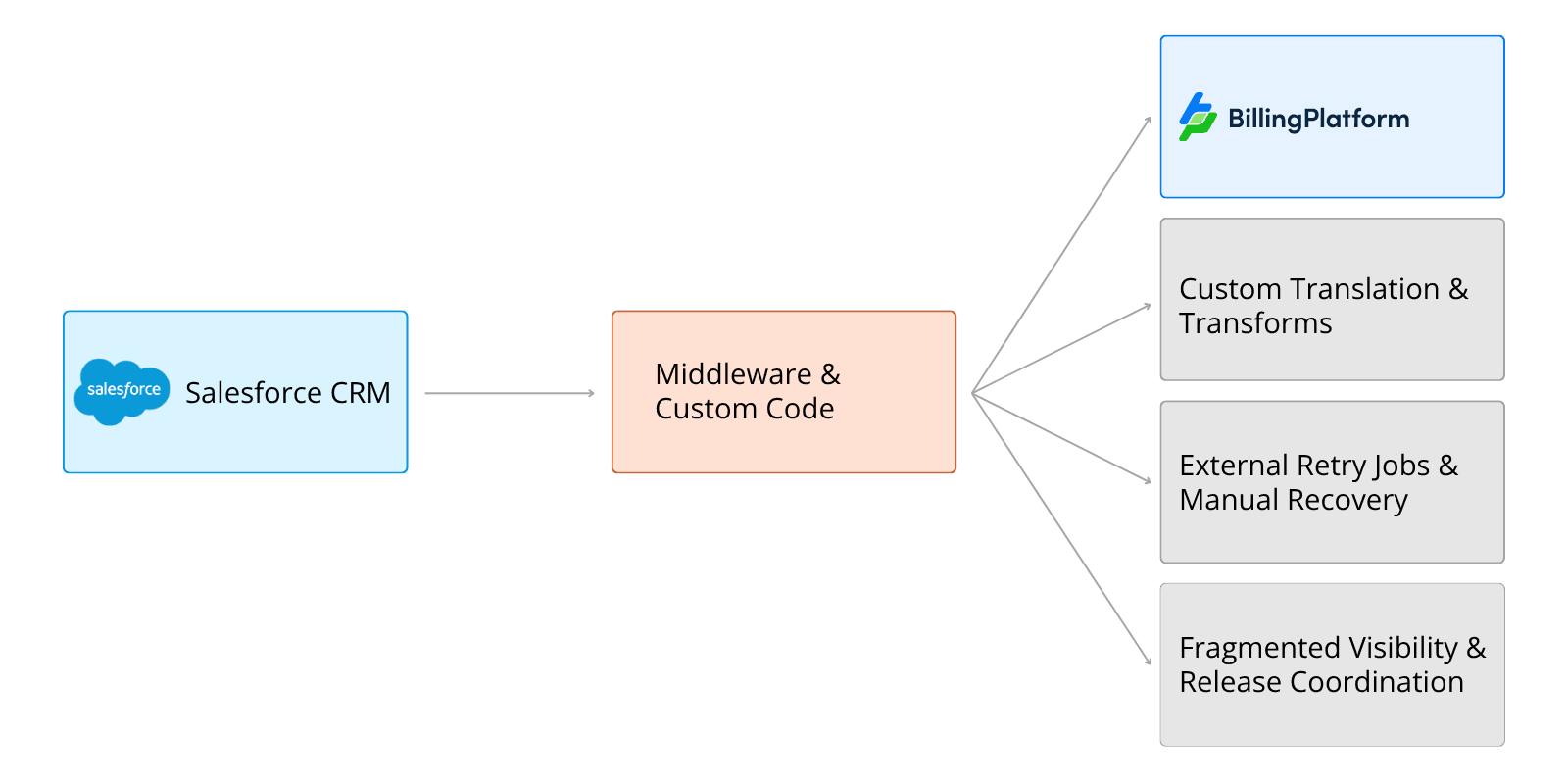
Middleware and Custom Integration Approach
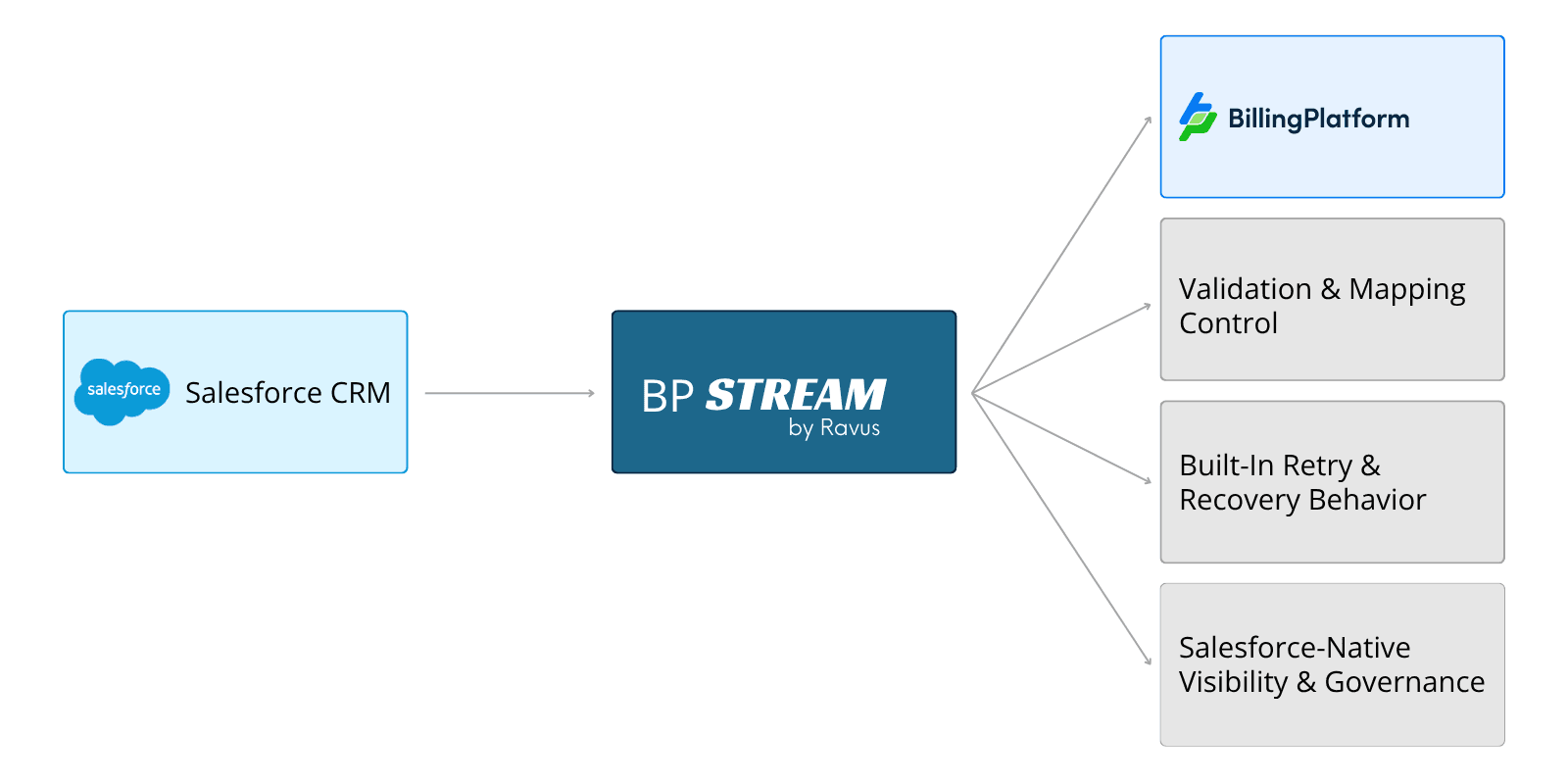
BP Stream Integration Approach
BP Stream offers a more direct alternative: real-time, Salesforce-native quote-to-revenue orchestration without the overhead of building and maintaining a middleware-centric integration layer.
That is why it matters.
If you are working through quote-to-cash challenges in BillingPlatform, reach out and we will show you how BP Stream works.
Evin Özer

Additional Resources
RAVUS PRODUCTS
BP Stream
Salesforce-native integration built by Ravus that provides real-time, bi-directional connectivity between Salesforce and BillingPlatform without external middleware or custom code.RAVUS PARTNERS
BillingPlatform
Ravus is a Premier BillingPlatform Implementation Partner helping enterprise teams modernize monetization, unify quote-to-cash, and run billing with confidence.