
A diagnostic framework for Finance, RevOps, and Billing leaders who want a clear, honest picture of where their organization is, and what a realistic path forward looks like.
By Elena Merrill, Ravus Co-Founder & Chief Operating Officer
May 4, 2026 | 21 minute readWe spend a lot of time in rooms where everyone agrees the revenue operations need work. Billing exceptions pile up at month-end. A pricing change that should take two weeks takes three months. The system that went live eighteen months ago is already showing its age. The data exists, but nobody fully trusts it.
What's harder to answer is: where exactly are we? Not in the abstract sense, but specifically enough to prioritize investment, build the business case, and align stakeholders who see the problem differently.
That's the problem this model is designed to solve.
We built this framework out of what we kept seeing on the ground - not from analyst research, but from engagements where the diagnosis was the work. From Missoula to Manhattan, the patterns repeat. The names change, the platforms change, the org charts change. What doesn't change is the gap between where an organization thinks it is and where it actually is.
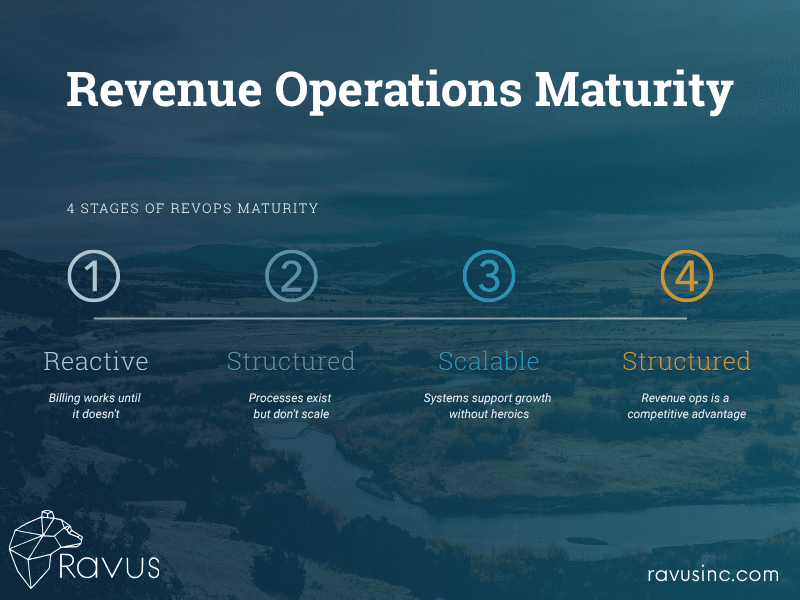
The Revenue Operations Maturity Model organizes the Q2C landscape into four stages. Not as a judgment - every organization starts somewhere - but as a diagnostic frame for identifying where your current state actually sits, which dimensions are strongest, and where the highest-leverage investment lies.
THE FOUR STAGES · REVENUE OPERATIONS MATURITY
Reactive
Billing works until it doesn'tStructured
Process exist but don't scaleScalable
Systems support growth without heroicsOptimized
Revenue ops is a competitive advantageA few things worth noting before you read into the stages.
First, most organizations don't land uniformly at one stage. Your process documentation might be Scalable while your data quality is still Reactive - that's normal, and often more actionable than a single aggregate score.
Second, the stages describe what's true today, not what you planned or what the vendor demo implied you'd be after go-live.
Third, Optimized is rarer than most maturity frameworks suggest. The organizations genuinely sitting there treat revenue operations as a continuous improvement function, not a completed project.
STAGE 01
Reactive
Billing works until it doesn'tYou may not recognize Stage 1 by name. You recognize it by what happens every month-end: the same manual scramble, the same exceptions handled case by case, the same spreadsheets doing work the system should be doing.
Reactive organizations aren't necessarily small or unsophisticated. Many have significant revenue, experienced teams, and real technology in place. The defining characteristic isn't size - it's that the revenue process was built to handle a version of the business that no longer exists, and the gap between what the system supports and what the business needs is being closed by people working harder than they should have to.
What it looks like in practice: Month-end requires manual reconciliation that depends on specific individuals who can't take vacation during close. Invoice exceptions are handled reactively, not systematically. The product catalog and pricing rules live partly in the system and partly in institutional knowledge. When someone leaves the billing team, critical process knowledge leaves with them. New offerings or pricing changes require significant ad hoc effort to support. Effort that lands on the same three people every time.
In nearly every Stage 1 engagement we’ve taken on, there’s a moment early in discovery when someone says some version of: “Oh, that’s just how [person’s name] does it, we’d have to ask her.” That sentence is the diagnosis. When a process lives in a person rather than a system, you don’t have a process. You have a dependency.
Signal
STAGE 02
Structured
Processes exist but don't scaleStage 2 is where well-intentioned first-generation investments land. There's a billing platform. There are documented processes. CPQ is in place. The system technically works. And yet, the manual workarounds are back. The integrations are brittle. Finance can close the books, but it requires the same people, the same heroics, every single time.
The risk in Stage 2 is false confidence. Enough infrastructure exists to feel like the problem is solved, which makes it harder to get investment for the next level. The actual cost isn't visible in any single quarter. It's the growth drag that compounds over time. Every new product, pricing change, or acquisition adds disproportionate complexity because the foundation doesn't absorb change gracefully.
What it looks like in practice: CPQ and billing are only loosely integrated. Quotes close in one system, billing is updated manually or through a fragile middleware connection. Reports exist but require significant preparation before they're ready for leadership review. The same two people in Finance know how the system actually works, and they carry that knowledge through every close, every exception, every ad hoc request that falls outside the normal path. The system was configured for the business as it was, not as it's becoming.
What Structured organizations typically tell themselves: "We just need to get through this quarter." "The system works - we just need better processes around it." These aren't unreasonable positions. We've said them ourselves on behalf of clients who weren't ready to hear the alternative. But they tend to hold indefinitely without a specific forcing function, and the forcing function usually arrives in the form of a pricing change, an acquisition, or an audit that exposes the fragility that was always there.
Signal
STAGE 03
Scalable
Systems support growth without heroicsStage 3 is the target state for most mature B2B enterprises — and it's achievable without being extraordinary. The core processes are automated. Integrations are stable. The team owns the system with confidence. Growth doesn't automatically mean more billing complexity, because the foundation was designed to absorb it.
This stage doesn't happen accidentally. It comes from a serious, well-executed investment: a proper implementation with clean data, thoughtful architecture, and — critically — an operating model built alongside the technology, not after go-live. The organizations that reach Stage 3 treated the implementation as the beginning of a program, not the end of a project.
We ask one question in every implementation design session that most teams aren’t expecting: “Who runs this on day 31?” Not who approves it, not who sponsored the project — who actually operates it the morning after the implementation team is gone. The organizations that answer that question clearly before go-live are the ones that reach Stage 3 and stay there.
What it looks like in practice: A closed opportunity in CRM initiates billing without manual intervention. Product catalog and pricing rules live in the system. Revenue reporting is reliable and requires minimal preparation for leadership review. New pricing models can be launched in weeks, not months. The team can train new members without a long ramp, because the system is documented and the processes are real.
Signal
STAGE 04
Optimized
Revenue operations is a competitive advantageStage 4 is rarer than most maturity frameworks imply, and it's worth being honest about that. A lot of organizations that describe themselves as Optimized are operating at a high Stage 3. True optimization is ongoing — it requires treating revenue operations as a continuous improvement function, with dedicated ownership, regular investment, and a seat in strategic conversations.
What distinguishes Optimized isn't just better technology. It's a different relationship between the revenue operations function and the rest of the business. Pricing decisions, product launches, and acquisitions are evaluated with revenue operations impact as a first-class input. The system proactively surfaces anomalies, leakage, and optimization opportunities — rather than waiting to be asked.
We’ve seen this work. It’s not a theoretical endpoint. But the organizations operating here share something in common that has nothing to do with their tech stack: their CFO or CRO treats revenue operations as a strategic function, not a cost center. That decision — made at the top, before any platform is selected — is what separates Stage 4 from Stage 3 more than any feature or integration ever could.
What it looks like in practice: Real-time revenue visibility across the full quote-to-cash lifecycle. Usage-based, hybrid, and complex pricing models are supported natively without manual intervention. AI-assisted anomaly detection, collections prioritization, and revenue forecasting are in active use. The finance close is fast, clean, and low-stress — a function of system integrity, not individual effort.
Worth saying plainly
Where do you actually sit? A five-dimension self-assessment
| Dimension | Stage 1: Reactive | Stage 2: Structured | Stage 3: Scalable | Stage 4: Optimized |
|---|---|---|---|---|
| Process documentation | Undocumented and tribal - lives in key people's heads | Documented but inconsistently followed - exceptions are common | Documented, enforced, and owned by defined roles | Continuously improved, version-controlled, and tied to outcomes |
| System integration | Manual handoffs between disconnected tools | Partial automation with brittle or batch-based connections | Real-time, stable, bi-directional integration across core systems | Fully automated with event-driven architecture and proactive monitoring |
| Data quality & accessibility | Unreliable and difficult to access - decisions made on gut | Exists but requires significant prep before it's trustworthy | Trusted, accessible, and used confidently in reporting | Real-time, self-service, and actively used to drive business decisions |
| Team capacity & capability | Dependent on key individuals - knowledge doesn't transfer | Capable team but stretched - capacity limits continuous improvement | Distributed ownership with documented onboarding and clear accountability | Dedicated RevOps function with defined development paths and career growth |
| Strategic alignment | RevOps is a cost center - involved after decisions are made | Nominally involved in planning - influence is limited in practice | Active participant in go-to-market and systems decisions | RevOps actively informs pricing, product, and business strategy |
What determines how fast you move
The distance between Reactive and Structured is usually shorter than people expect. A focused advisory engagement, a clean data foundation, and a clear set of requirements can move an organization through Stage 1 in a matter of months.
The distance between Structured and Scalable is almost always longer. Not because the technology is harder — but because Structured organizations have just enough infrastructure to feel like the problem is solved. Getting investment for the next level requires making the cost of staying at Stage 2 visible, which is harder than making the pain of Stage 1 visible. Stage 1 hurts obviously. Stage 2 drags quietly.
The distance between Reactive and Structured is usually shorter than people expect. A focused advisory engagement, a clean data foundation, and a clear set of requirements can move an organization through Stage 1 in a matter of months.
The distance between Structured and Scalable is almost always longer. Not because the technology is harder — but because Structured organizations have just enough infrastructure to feel like the problem is solved. Getting investment for the next level requires making the cost of staying at Stage 2 visible, which is harder than making the pain of Stage 1 visible. Stage 1 hurts obviously. Stage 2 drags quietly.
The distance between Reactive and Structured is usually shorter than people expect. A focused advisory engagement, a clean data foundation, and a clear set of requirements can move an organization through Stage 1 in a matter of months.
The distance between Structured and Scalable is almost always longer. Not because the technology is harder — but because Structured organizations have just enough infrastructure to feel like the problem is solved. Getting investment for the next level requires making the cost of staying at Stage 2 visible, which is harder than making the pain of Stage 1 visible. Stage 1 hurts obviously. Stage 2 drags quietly.
What comes next
If the framework surfaced a clear picture of where you stand — and where the highest-leverage gaps are — the Revenue Systems Assessment is the structured next step. It’s a time-boxed advisory engagement that validates your current-state diagnosis, evaluates platform fit if a selection is upcoming, and builds a prioritized roadmap tied to your specific business outcomes. We designed it specifically for the conversation that should happen before any major commitment is made.
The organizations that move through this model fastest aren’t the ones with the biggest budgets or the most urgent pain. They’re the ones that were honest about where they were starting from — and found a partner willing to be equally honest with them. That’s the only kind of engagement we know how to do.
Book a Revenue Systems Assessment
Elena Merrill
Co-Founder & Chief Operating Officer
Elena focuses on helping organizations solve complex problems through technology, operating alignment, and cross-functional execution. Her background includes architecture and delivery leadership across revenue-focused environments, including Salesforce Revenue Cloud and related business processes.